The 1994 statement permitting girl servers was a mistaken tactical retreat which led to a fall in priestly vocations. It’s time to withdraw it
Undoing the damage will take time: the sooner the Church starts to clear up the mess, the better
By William Oddie
The rector of the Catholic Cathedral of Phoenix, Arizona, has decided that girls will no longer be allowed as altar servers (though they will continue elsewhere in the diocese). His reason is simple: he thinks that an all-male sanctuary promotes vocations to the priesthood. “The connection between serving at the altar and priesthood is historic,” he says: “it is part of the differentiation between boys and girls, as Christ established the priesthood by choosing men. Serving at the altar is a specifically priestly act.” I’m not sure, to be pedantic, that that’s entirely orthodox (in the context of the Mass, only the priest himself performs specifically priestly acts), but one knows exactly what he means: what the server does is intimately related to the Eucharistic action and can be seen as an intrinsic part of it: the server is a kind of extension of the priest himself; if there were no servers, the priest would do what they do. According to Fr Lankeit, 80 to 95 percent of priests served as altar boys.
The question is, why shouldn’t that happen when there are also girl servers? There are two reasons: firstly because the causal link between servers and priestly vocations is weakened if some or most of the servers in the sanctuary are excluded from it. But secondly because as soon as girls appear, the supply of altar boys tends simply to dry up.
The first time this occurred to me was in the house of friends with whom I was staying in France. One of the guests at dinner one evening was Archbishop André Vingt-Trois of Tours (now Cardinal Archbishop of Paris). The subject of conversation at one point was the way in which, in the local Parish Church, presumably in an attempt to involve women in the celebration of the Mass, not only were all the readers women but so also were all the servers girls; my wife (not I) compared it to a farmyard, with the priest as the cock strutting about in the middle of a flock of hens. Archbishop Vingt-Trois said that the priest may have had no choice over the all-girls serving team: “Once the girls arrive, he said, the boys disappear: you can’t see them for dust” (his explanation was much more graphic in French). And he was adamant that though there were, of course other factors contributing to the decline in priestly vocations, the decline in the number of all-male sanctuaries was certainly one of them.
I suspect, though there’s no way to prove this, that many if not most Catholics, once they think about it, will have the feeling that this is either obviously true, or at the very least a plausible hypothesis. For what it’s worth, the US website Catholic Answers carried out a poll in which they asked the question “does having girl altar boys help with vocations to the priesthood?”
The answers were as follows:
YES, Girl Altar Boys help Vocations To The Priesthood: 2.98%
NO, Girl Altar Boys don’t Help Vocations To The Priesthood: 64.29%
Girl Altar Boys, Have No Effect At All On Vocations To The Priesthood: 32.74%
Voters: 168It’s a pretty small sample, of course: but I would be surprised if it’s not true that almost nobody thinks that girl servers help vocations to the priesthood, that of the remainder, about two thirds think it doesn’t help, and another third thinks it makes no difference. If the question had been asked differently: if the question had been “does an all-male sanctuary foster vocations to the priesthood?”, I suspect that more than that two thirds would have replied “yes”, since historically it has observably done so. In the US, only one diocese now restricts serving at the altar to boys and men, Lincoln, Nebraska, and it is apparently the case that vocations there are higher than elsewhere.
The late Pope was opposed to the practice, and didn’t allow it in his own diocese of Rome: so why on his watch, in 1994, was the rule that only men and boys could serve at the altar (which had been firmly reimposed by Pope Paul VI and Pope John Paul himself) relaxed? It’s a puzzler. Some say it was inevitable since, especially in the US, it was already being widely defied: but all kinds of things the Church is against are indulged in defiantly by disobedient Catholics, and the Church quite rightly doesn’t give an inch. One theory is that it was a tactical retreat to avoid legal action. As the writer David L Sonnier explains it,
Take a moment to recall the circumstances under which this practice was allowed. We lived in a hostile political climate in 1994; the politicians in Washington were condemning the Catholic Church for not ordaining women, and ridiculing the Church for Her stand against abortion. It seemed that according to these critics at the highest level of the Clinton administration, the Catholic Church would not be qualified to address the issue of abortion until women were ordained.
In 1994 a document from the Pontifical Council for the Interpretation of Legislative Texts gave some room for the novel practice of “female altar servers” under political pressure from the U.S., but nevertheless insisted that “the obligation to support groups of altar boys will always remain…” due, of course, to the relationship between service at the altar and future vocations. Has there been any such support for “groups of altar boys?”
Well, no: of course there hasn’t, because as soon as the girls appeared, the “groups of altar boys”, as Archbishop Vingt-Trois put it, couldn’t be seen for dust. But could the document be withdrawn? It won’t be easy: there are already so many girl servers. But they tend to disappear when they grow up. And though no bishop may impose them on his priests, he does have the right to forbid them. This is the paradox; he may not impose girls—but he still may impose boys, as may any of his priests.
And this could be the time to start: radical feminism is much less of a threat than it was, and may be confronted more readily than it could, say, in the US in the eighties. I remember vividly arranging my notes before delivering a lecture on feminist theology in the General (Episcopalian) Seminary in New York, in 1983. I was approached by a male seminarian, who said simply, “Oh Dr Oddie, I just wanted to tell you, since I know your views, how much we admire your courage in coming here to explain them”. “I need courage”, I replied, slightly alarmed: “Oh yes”, he said, and disappeared. And so it proved: I was heckled repeatedly, but I think I gave as good as I got, and the evening was an exhilarating one in the end.
The church has not entirely given in on this, and little by little, girl servers could be phased out: a final date could perhaps be announced for this to be achieved, diocese by diocese, parish by parish. The tradition is still solidly there, beneath the surface. As David L Sonnier puts it,
Let’s take it one point at a time. First of all, the Holy Father does not allow Girl Altar Boys within his own Diocese of Rome. That should be enough to give pause to a number of people who currently see nothing wrong with the practice.…
Second, this practice of placing girls at the altar has absolutely nothing to do with Vatican II and was condemned in the strongest of terms twice following the council. In 1970 Pope Paul VI said in Liturgicae Instaurationes, “In conformity with norms traditional in the Church, women (single, married, religious), whether in churches, homes, convents, schools, or institutions for women, are barred from serving the priest at the altar.”
And in 1980 Pope John Paul II stated in Inaestimabile Donum, “There are, of course, various roles that women can perform in the liturgical assembly: these include reading of the Word of God and proclaiming the intentions of the Prayer of the Faithful. Women are not, however, permitted to act as altar servers.”
That is the tradition of the Church to which we should now return. To begin with, that 1994 statement by the Pontifical Council for the Interpretation of Legislative Texts (I bet you’d never heard of them) should be simply withdrawn. Why not? Its issue was a huge mistake, whose consequences have been disastrous: It’s time now to begin to repair the damage. It may take some time: so the sooner we start the better. Any priest who reads this can start on Sunday: a bishop could get on the phone today.

Showing posts with label pope john paul Ii. Show all posts
Showing posts with label pope john paul Ii. Show all posts
Thursday, August 25, 2011
More On Altar Girls
Just the other day I posted on the travesty that are altar girls. Here is an opinion piece appearing in the UK's Catholic Herald by William Oddie.


Friday, April 1, 2011
Breaking News!
 Wow, never thought I'd see this! The beatification of John Paul II which was scheduled for May 1 has been postponed. Pope Benedict has called it off due to "irregularities" concerning the so-called single miracle needed.
Indefinately.
Read the story here!
Thanks to Athanasius Contra Mundum for the heads up.
Thursday, February 18, 2010
Santo Subito? I Think Not.
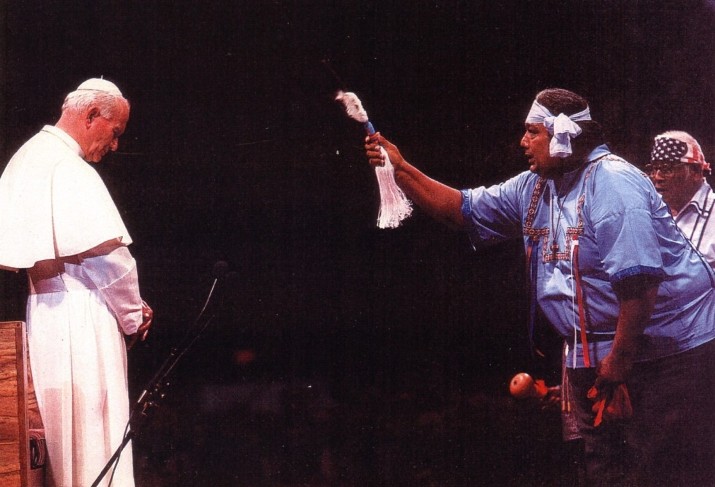 I promised some time ago to write on this topic, but have not felt motivated to do so. I am now.
I made mention that I did not think John Paul II was a good candidate for Sainthood. Now calm down, I know he was popular and everybody loved him, he was a rock star, yadda, yadda.
That doesn't make him a Saint. And while I am not doubting his virtue or his sincerity, the failures of the late Pontiff were in his role as a shepherd and guardian of the Deposit of Faith.
And please don't leave me comments bemoaning the fact that I did not know his heart and all of that guff. I know what he did and what he didn't do, and that is all I need.
Here's a few of the stupid things he did, which the Pope should never do.
1. He kissed the Koran. Plus he actually said the words "I receive the word of God" If the word of God is contained anywhere in the Koran then the Catholic faith is a sham. There are Martyrs of the Church that died rather than kiss the Koran. He did it willingly.
2. He refused to reign in his Bishops who worked diligently to destroy the faith of Catholics worldwide.
3. During his reign the Catholic Church had fallen deep into disrepair. The current crisis in the Church is a direct consequence of his inability to shepherd it and his nurturing of the false "Spirit of Vatican II".
4. He allowed, promoted, and engaged in heretical gatherings at Assisi, standing among pagans, joining in their rituals. Never once did he try to evangelize them, giving scandal to the faithful and Holy Mother Church.
5. In Evangelium Vitae he contradicted 2000 years of Church teaching when he wrote that unbaptized babies go to Heaven. His error was later removed by the Vatican.
6. Let's not overlook his "World Youth Day" rock extravaganzas! Previous Popes behaved with decorum and modesty. Not this one.
In my opinion, Pope John Paul II brought scandal to the church, he disgraced the office of the Papacy by his poor Catholicity, he left virtually nothing of the faith to hand down, not to mention his many intentional breaks with Tradition. A bad Pontificate.
Tuesday, December 22, 2009
Pius XII, JPII, 'Venerable'
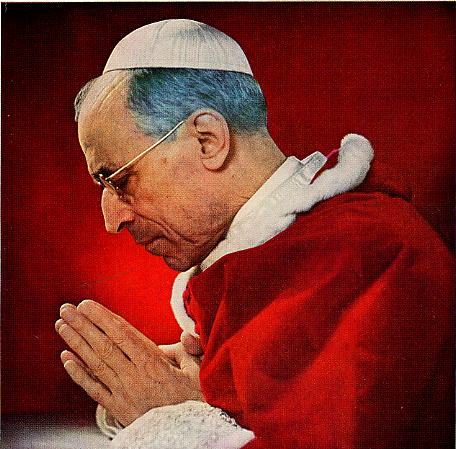 With all the goings on at the courthouse this weekend, I forgot to get this good news up. I am most pleased about Pius XII, a particular target for the liberals.
Popes Pius XII, John Paul II declared 'venerable'
Catholic World News
December 19, 2009
http://www.catholicculture.org/news/headlines/index.cfm?storyid=4969
In a series of decrees issued on December 19, the Vatican has approved miracles allowing for the canonization of five people and the beatification of five others. The Vatican also recognized the 1984 death of Father Jerzy Popieluszko as a martyrdom, preparing the way for his beatification.
The decrees, approved by Pope Benedict XVI during a private audience with Cardinal Angelo Amato, prefect of the Congregation for the Causes of Saints, also proclaimed that ten other candidates for sainthood had lived lives of heroic virtue. Those decrees make the candidates eligible for beatification if a miracle is attributed to their intercession.
The two decrees commanding the greatest public attention were those recognizing the heroic virtue of Pope Pius XII, who reigned from 1939 to 1958, and Pope John Paul II, who reigned from 1978 to 2005.
Five of the December 19 decrees testified to the authenticity of miracles attributed to candidates who have already been beatified, and are now qualified for canonization. They are:
•Bl. Stanislaus Soltys (Kazimierczyk) (1433-89), whose liturgical cult was formally recognized by Pope John Paul in 1993
•Bl. André Bessette (1845-1937), a Canadian renowned for his devotion to St. Joseph who developed a reputation as a miracle worker in his lifetime
•Bl. Mary MacKillop (1842-1909), who founded the Sisters of St. Joseph of the Sacred Heart and will become Australia’s first canonized saint
•Bl. Giulia Salzano (1846-1929), foundress of the Congregation of the Catechetical Sisters of the Sacred Heart
•Bl. Camilla Battista da Varano (1458-1524), a Poor Clare nun
The Congregation also approved miracles for five other candidates who, like Father Popieluszko, will now be scheduled for beatification:
•Father José Tous y Soler (1811-71), a Capuchin Franciscan
•Brother Leopoldo de Alpandeire (1866-1956), a Capuchin Franciscan
•Manuel Lozano Garrido (1920-71), a Spanish layman
•Teresa Manganiello (1849-76), a Third Order Franciscan
•Chiara Badano (1971-90), a laywoman of the Focolare Movement
In addition, the Congregation declared the heroic virtue of Bl. Giacomo Illirico da Bitetto, a Franciscan.
The Congregation also proclaimed the heroic virtue of nine others, who now qualify for the title "Venerable" and may be beatified with the approval of a miracle:
•Pope Pius XII (Eugenio Pacelli) (1876-1958)
•Pope John Paul II (Karol Wojtyla) (1920-2005)
•Father Louis Brisson (1817-1908), founder of the Oblates of Saint Francis de Sales
•Father Giuseppe Quadrio (1921-63), a Salesian
•Sister Mary Ward (1545-1615), an Englishwoman who founded the Institute of the Blessed Virgin Mary (Loreto Sisters)
•Sister Antonia Maria Verna (1773-1838), foundress of the Sisters of Charity of the Immaculate Conception of Ivrea
•Sister Francesca Farolfi (Maria Chiara Serafina of Jesus) (1853-1917), foundress of the Missionary Franciscan Clarists of the Blessed Sacrament
•Sister Enrichetta Alfieri (1891-1951)
•Giunio Tinarelli (1912-56), a layman and member of the Silent Workers of the Cross
Wednesday, September 30, 2009
The Neon Mysteries
 In another post I wrote that Pope John Paul II had "screwed around with the Rosary".
To understand my statement, one must view from a scholarly standpoint what the Rosary actually is. There are those who rightly say that the Rosary is a part of the small "t" tradition of the Church, and therefore can be changed. That doesn't mean to say that it should be changed.
What I mean by this is that while I feel smoking my pipe and wearing my kilt and having picnics are all fine to do, I shouldn't do these things in Church because they are wildly inappropriate. The same goes for changing the Rosary.
If JPII wanted the faithful to meditate on the public ministry of Jesus Christ, there are better ways to do so rather than changing traditions. But as has been poined out by a regular reader, the Pope is well within his rights to do so.
But.
The Pope is also the defender of the Catholic Church and its Traditions and traditions. He also has the duty to hand down the unadulterated Faith to others.
So now let's look at the Rosary's history a bit.
Way back in the day, the faithful prayed all 150 psalms. (Try getting some Catholics today to pray one decade of the Rosary...!) As we move into the Middle Ages, people had trouble learning all the psalms, and they longed for a way to do it, so at some point to help these folks, the tradition began of saying 150 Pater Nosters, and in time it eventually became 150 Ave Maria's.
This tradition of saying 150 Ave Maria's was already well under way for hundreds of years by the time Saint Dominic Gusman came along and was told by the Blessed Mother at the church at Prouille "Wonder not that you have obtained so little fruit by your labors, you have spent them on barren soil, not yet watered with the dew of Divine Grace. When GOD willed to renew the face of the earth, He began by sending down on it the fertilizing rain of the Angelic Salutation. Therefore preach my Psalter composed of 150 Angelic Salutations and 15 Our Fathers, and you will obtain an abundant harvest".
It was thereafter known as Our Lady's Psalter. "Psalter" because as I explained, the Rosary is modeled off of the Breviary, with it's 150 Ave Maria's in place of the 150 Psalms. But when John Paul the Innovator decided to add mysteries to the Rosary, by adding 50 Ave's, the whole structure of the traditional Rosary is screwed up.
Hence, JPII screwed with the Rosary. If you don't like my choice of words, remember it could have been much worse.
So we can see that now with the new mysteries suggested by JPII, we have 200 Ave's instead of the traditional 150. But this is no great surprise, for in this great time of Catholic awakening since Vatican II, priests and religious don't even say the 150 psalms anymore because the VII genuises omitted some of the psalms in the newer form of the Breviary.
So, let's get back to small "t" traditions in the post Vatican II era and changing the Rosary. History has shown that whenever the Novus Ordites want to attack capital "T" Tradition, they always go after the small "t" traditions, and during our post Vatican II springtime we have seen it time and again. They went after Latin, Chant, the Mass (!), the Eucharistic fast, Communion on the tongue, Communion kneeling, they removed Prime from the Breviary for whatever reason, they instituted altar girls and EMHC's, they allowed women in the Sanctuary, and they threw out saints because they claimed there wasn't enough proof they existed.
And that's just the tip of the iceberg.
When you attack traditions, you attack the Traditions handed down by the Apostles themselves, and you breakdown traditional devotion and piety. When you change traditions you change the religion. If you don't think that is the case, have a look around at the havoc that has been wrought in the Church the last forty years.
And that true believers, is why changing the Rosary is a bad idea.
Ok?
Subscribe to:
Posts (Atom)