Showing posts with label Traditions. Show all posts

Thursday, February 18, 2010

Our Church Belongs To Us!

Here is a great article written by John Zmirak of Inside Catholic. Be sure to go and read the rest.

All Your Church Are Belong To Us
By John Zmirak
"Why do you people care so much about externals?" my non-Trad friends sometimes ask me. And they deserve an answer. A few weeks back, my delightfully contentious colleague here, Mark Shea, waded into the conflict between those who describe themselves simply as "orthodox" Catholics, and those who consider themselves "traditionalists." (Just to save space in the comments box, I mean by this term people who favor the traditional liturgy -- not those who associate with organizations under ecclesiastical suspension.)This line has begun to blur more and more in the wake of Pope Benedict XVI's Summorum Pontificum, which we Trads greeted as a kind of Emancipation Proclamation -- even as many of our bishops answered it with liturgical Jim Crow.
Still, the division is palpable. It was lying right there on the table, for any who cared to palpate it, last week when I went to dinner with a Trad-minded colleague and a visiting author who'd come to speak at our college on G. K. Chesterton. (The presentation was riveting, and I highly recommend Dale Ahlquist's talks and books.) Like the good Mr. Shea, our speaker is a convert, and he shared with Mark a puzzlement at the apparent fixation traditionalists have on restoring former elements of the liturgy and other Catholic practices that are not essential, and resisting innovations that are not inherently evil. Having come from churches that didn't have the Eucharist, and remaining through God's grace flush with gratitude for the sacraments, many converts really don't understand what the rest of us are nattering on about. We who grew up privileged may seem like sulky, spoiled kids. We owe these good people an explanation.
Sometimes they think we just care about aesthetics. One visit to a Sunday Latin Low Mass without music, recited soundlessly into a marble altar, should put that idea to flight. Compared to a Novus Ordo liturgy in the vernacular, and from a purely human point of view, attending Low Mass can be dull. You feel like you are eavesdropping. If you follow along in the missal, you can feel that you are watching a very solemn foreign film without any subtitles, except that you have the screenplay. There's a reason the old rubrics relegated Low Mass to weekdays, and called (though they were rarely answered) for sung Solemn Mass on Sundays and holy days. Pope Pius X wasn't kidding when he asked for parishes to revive Gregorian chant and teach it to the laity. Nor is there any good reason why Latin Mass congregations don't give the responses along with the servers -- except perhaps the fear that this is somehow the first step down a long road that leads to clown Mass. Get over it, fratres.
Other people think that we are a band of Latin scholars, desperate to put our dusty declensions to practical use. Again, one conversation with the congregants at the coffee hour will dash that infant theory against the rocks. Most of us studied Latin, if at all, as part of vocabulary practice for the SATs, and follow the English side of the missal. I don't know a single Traditionalist who wouldn't prefer the old Mass, facing the altar, said in English, to the Novus Ordo chanted in Latin facing the people. While the universal language of the Church is still to be revered for all the reasons that Vatican II prescribed in Sacrosanctum Concilium, it isn't Why We Fight.

Continue

Tuesday, December 22, 2009

More On SSPX - Rome

Some News about the SSPX Discussions

by Gregor Kollmorgen
New Liturgical Movement
Tuesday, December 22, 2009
http://www.newliturgicalmovement.org/2009/12/some-news-about-sspx-discussions.html

Via the website Panorama Católico Internacional (found via messainlatino.it) come news about the doctrinal discussions between the Holy See and the SSPX.

The follwing is a synthesis of remarks made by Bishop Alfonso de Galareta, head of the SSPX delegation for the discussions, on the occasion of recent ordinations of the SSPX at its Argentinian seminary of La Reja.


1) The outcome of the first meeting has been good.

2) Primarily the agenda and the method of discussion were established.

3) The issues to be discussed are of a doctrinal nature to the express exclusion of any canonical question regarding the situation of the SSPX.

4) The common doctrinal reference point will be the Magisterium prior to the Council.

5) The talks follow a rigorous method: an issue is raised, and the party raising it sends a paper substantiating its doubts. The Holy See responds in writing, after prior email exchanges among the technical advisers. At the meeting, the issue is discussed.

6) All meetings are taped by both parties and filmed.

7) The conclusions of each topic will be submitted to the Holy Father and the Superior General of the SSPX.

8) The timing of these meetings depends on whether the topic is new or is already being discussed. In the first case, it will be approximately every three months. In the second, every two. The next meeting is planned for mid January.

10) The theological representatives of the Holy See "are people you can talk with", they speak "the same (theological) language as we". (meaning presumably they are Thomists).

11) Some of the topics mentioned by the bishop in his homily, not exhaustively, are:

a) The Magisterium of the Council and after the Council.

b) The conciliar liturgical reform.

c) Ecumenism and interreligious dialogue.

e) Papal authority and collegiality.

f) Freedom of conscience, religious freedom, secularism and the social reign of Jesus Christ.

g) Human rights and human dignity according to the Council's teaching.

The Bishop repeated that the results of the first session are good, compared to the previous situation. The parties talked entirely freely and only about doctrinal issues in a Thomist theological framework.

No one can foresee what will happen in the future. One will move forward day by day, as prudence and evangelical spirit direct.

Monday, November 30, 2009

Has The End Game Started?

I know this will make some of you mad, I know this will make some of you happy, and others yet will go into damage control mode. Right chancery officials? Enjoy the latest from The Vortex!

Wednesday, November 25, 2009

Let's Go!

It seems it is time for the Traditionalists to step up to the plate. The Diocese has begun making arbitrary rules to deny Catholics of their rights. This will not stand.

Stay tuned, true believers.

Tuesday, November 10, 2009

Just Beautiful!


I just came across this over at the New Liturgical Movement and I had to steal it to show it to you.

An All Soul's requiem Mass from St. Joseph's Church in Woonsocket Rhode Island. Note the beautiful brocade on the veil and chasuble.

Wednesday, September 30, 2009

The Neon Mysteries

In another post I wrote that Pope John Paul II had "screwed around with the Rosary".

To understand my statement, one must view from a scholarly standpoint what the Rosary actually is. There are those who rightly say that the Rosary is a part of the small "t" tradition of the Church, and therefore can be changed. That doesn't mean to say that it should be changed.

What I mean by this is that while I feel smoking my pipe and wearing my kilt and having picnics are all fine to do, I shouldn't do these things in Church because they are wildly inappropriate. The same goes for changing the Rosary.

If JPII wanted the faithful to meditate on the public ministry of Jesus Christ, there are better ways to do so rather than changing traditions. But as has been poined out by a regular reader, the Pope is well within his rights to do so.

But.

The Pope is also the defender of the Catholic Church and its Traditions and traditions. He also has the duty to hand down the unadulterated Faith to others.

So now let's look at the Rosary's history a bit.

Way back in the day, the faithful prayed all 150 psalms. (Try getting some Catholics today to pray one decade of the Rosary...!) As we move into the Middle Ages, people had trouble learning all the psalms, and they longed for a way to do it, so at some point to help these folks, the tradition began of saying 150 Pater Nosters, and in time it eventually became 150 Ave Maria's.

This tradition of saying 150 Ave Maria's was already well under way for hundreds of years by the time Saint Dominic Gusman came along and was told by the Blessed Mother at the church at Prouille "Wonder not that you have obtained so little fruit by your labors, you have spent them on barren soil, not yet watered with the dew of Divine Grace. When GOD willed to renew the face of the earth, He began by sending down on it the fertilizing rain of the Angelic Salutation. Therefore preach my Psalter composed of 150 Angelic Salutations and 15 Our Fathers, and you will obtain an abundant harvest".

It was thereafter known as Our Lady's Psalter. "Psalter" because as I explained, the Rosary is modeled off of the Breviary, with it's 150 Ave Maria's in place of the 150 Psalms. But when John Paul the Innovator decided to add mysteries to the Rosary, by adding 50 Ave's, the whole structure of the traditional Rosary is screwed up.

Hence, JPII screwed with the Rosary. If you don't like my choice of words, remember it could have been much worse.

So we can see that now with the new mysteries suggested by JPII, we have 200 Ave's instead of the traditional 150. But this is no great surprise, for in this great time of Catholic awakening since Vatican II, priests and religious don't even say the 150 psalms anymore because the VII genuises omitted some of the psalms in the newer form of the Breviary.

So, let's get back to small "t" traditions in the post Vatican II era and changing the Rosary. History has shown that whenever the Novus Ordites want to attack capital "T" Tradition, they always go after the small "t" traditions, and during our post Vatican II springtime we have seen it time and again. They went after Latin, Chant, the Mass (!), the Eucharistic fast, Communion on the tongue, Communion kneeling, they removed Prime from the Breviary for whatever reason, they instituted altar girls and EMHC's, they allowed women in the Sanctuary, and they threw out saints because they claimed there wasn't enough proof they existed.

And that's just the tip of the iceberg.

When you attack traditions, you attack the Traditions handed down by the Apostles themselves, and you breakdown traditional devotion and piety. When you change traditions you change the religion. If you don't think that is the case, have a look around at the havoc that has been wrought in the Church the last forty years.

And that true believers, is why changing the Rosary is a bad idea.

Ok?

Monday, August 3, 2009

Are you in a different Church?

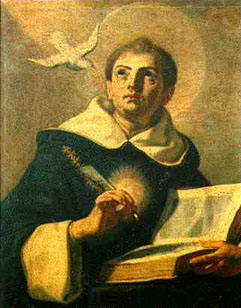
Ponder the writing of Saint Thomas Aquinas:

"'One faith,' St. Paul writes (Eph. 4:5). Hold most firmly that our faith is identical with that of the ancients. Deny this, and you dissolve the unity of the Church ... We must hold this for certain, namely: that the faith of the people at the present day is one with the faith of the people in past centuries. Were this not true, then we would be in a different church than they were in and, literally, the Church would not be One." – St. Thomas Aquinas

Wednesday, February 25, 2009

Happy Ash Wednesday!

And also Happy Lent which begins today! Put down that chicken leg, chubby. It's time to fast and abstain!

From my friends over at Fisheaters.com, we have this Lenten Overview.


Lent (the word "Lent" comes from the Old English "lencten," meaning "springtime) lasts from Ash Wednesday to the Vespers of Holy Saturday -- forty days + six Sundays which don't count as "Lent" liturgically. The Latin name for Lent, Quadragesima, means forty and refers to the forty days Christ spent in the desert which is the origin of the Season.The last two weeks of Lent are known as "Passiontide," made up of Passion Week and Holy Week. The last three days of Holy Week -- Maundy Thursday, Good Friday, and Holy Saturday -- are known as the "Sacred Triduum."

The focus of this Season is the Cross and penance, penance, penance as we imitate Christ's forty days of fasting, like Moses and Elias before Him, and await the triumph of Easter. We fast (see below), abstain, mortify the flesh, give alms, and think more of charitable works. Awakening each morning with the thought, "How might I make amends for my sins? How can I serve God in a reparative way? How can I serve others today?" is the attitude to have.

We also practice mortifications by "giving up something" that would be a sacrifice to do without. The sacrifice could be anything from desserts to television to the marital embrace, and it can entail, too, taking on something unpleasant that we'd normally avoid, for example, going out of one's way to do another's chores, performing "random acts of kindness," etc. A practice that might help some, especially small children, to think sacrificially is to make use of "Sacrifice Beads" in the same way that St. Thérèse of Lisieux did as a child.

Because of the focus on penance and reparation, it is traditional to make sure we go to Confession at least once during this Season to fulfill the precept of the Church that we go to Confession at least once a year, and receive the Eucharist at least once a year during Eastertide. A beautiful old custom associated with Lenten Confession is to, before going to see the priest, bow before each member of your household and to any you've sinned against, and say, "In the Name of Christ, forgive me if I've offended you." One responds with "God will forgive you." Done with an extensive examination of conscience and a sincere heart, this practice can be quite healing (also note that confessing sins to a priest is a Sacrament which remits mortal and venial sins; confessing sins to those you've offended is a sacramental which, like all sacramentals one piously takes advantage of, remits venial sins. Both are quite good for the soul!)

In addition to mortification and charity, seeing and living Lent as a forty day spiritual retreat is a good thing to do. Spiritual reading should be engaged in (over and above one's regular Lectio Divina). Maria von Trapp recommended "the Book of Jeremias and the works of Saints, such as The Ascent of Mount Carmel, by St. John of the Cross; The Introduction to a Devout Life, by St. Francis de Sales; The Story of a Soul, by St. Thérèse of Lisieux; The Spiritual Castle, by St. Teresa of Avila; the Soul of the Apostolate, by Abbot Chautard; the books of Abbot Marmion, and similar works."

As to prayer, praying the beautiful Seven Penitential Psalms (Psalms 6, 31, 37, 50, 101, 129, and 142) is a traditional practice. It is most traditional to pray all of these each day of Lent, but if time is an issue, you can pray them all on just the Fridays of Lent, or, because there are seven of them, and seven Fridays in Lent, you might want to consider praying one on each Friday. These Psalms, which include the Psalms "Miserére" and "De Profundis," are perfect expressions of contrition and prayers for mercy. So apt are these Psalms at expressing contrition that, as he lay dying in A.D. 430, St. Augustine asked that a monk write them in large letters near his bed so he could easily read them.

Another great prayer for this season is that of St. Ephraem, Doctor of the Church (d. 373). This prayer is often prayed with a prostration after each stanza:
O Lord and Master of my life, take from me the spirit of sloth, despondency, lust of power, and idle talk;

But grant rather the spirit of chastity, humility, patience, and love to thy servant.

Yea, O Lord and King, grant me to see my own transgressions, and not to judge my brother; for blessed art Thou unto the ages of ages.

In the East, this prayer is prayed liturgically during Lent and is followed by "O God, cleanse me a sinner" prayed twelve times, with a bow following each, and one last prostration.

Also, on all Fridays during Lent, one may gain a plenary indulgence, under the usual conditions, by reciting the En ego, O bone et dulcissime Iesu (Prayer Before a Crucifix) before an image of Christ crucified.

Food in Lent

According to the 1983 Code of Canon Law, the rule for the universal Church during Lent is abstain on all Fridays (inside or outside of Lent) and to both fast and abstain on Ash Wednesday and Good Friday.

Some traditional Catholics might follow the older pattern of fasting and abstinence during this time, which for the universal Church required:

  • Ash Wednesday, all Fridays, and all Saturdays: fasting and total abstinence. This means 3 meatless meals -- with the two smaller meals not equalling in size the main meal of the day -- and no snacking.
  • Mondays, Tuesdays, Wednesdays (except Ash Wednesday), and Thursdays: fasting and partial abstinence from meat. This means three meals -- with the two smaller meals not equalling in size the main meal of the day -- and no snacking, but meat can be eaten at the principle meal.

On those days of fasting and abstinence, meatless soup is traditional (see recipes). Sundays, of course, are always free of fasting and abstinence; even in the heart of Lent, Sundays are about the glorious Resurrection. This pattern of fasting and abstinence ends after the Vigil Mass of Holy Saturday.

As to special Lenten foods, vegetables, seafoods, salads, pastas, and beans mark the Season, in addition to the meatless soups. The fasting of this time once even precluded the eating of eggs and fats, so the chewy pretzel became the bread and symbol of the times. They'd always been a Christian food, ever since Roman times, their very shape being the creation of monks. The three holes represent the Holy Trinity, and the twists of the dough represent the arms of someone praying. In fact, the word "pretzel" is a German word deriving ultimately from the Latin "bracellae," meaning "little arms" (the Vatican has the oldest known representation of a pretzel, found on a 5th c. manuscript).

Tuesday, February 24, 2009

Shrove Tuesday

From Fisheaters.com, the absolute best web-site to learn the truth and traditions of the Catholic Church.

Towards the end of this post, you will learn about Paczki (poonch-key). I have these every year as well as the King's cake. Both are awaiting my arrival at the homestead, where they will be gobbled up in short order before Lent begins tomorow. I have actually been known to down the final Paczki at 11:59pm, and then go to bed fat and happy. That's a great feeling, the fat and happy thing!

Of course we Irish don't have something as excellent as the Paczki, so I'm lucky I married a Pol!

The Monday and Tuesday before Ash Wednesday are known as "Shrovetide," from an old English word "shrive," meaning "to confess," a name gotten from the tradition of going to Confession in the days before Lent started. Shrovetide is traditionally the time for "spring cleaning," and just as we clean our houses in these days in prepation for Lent, we also "clean our souls" through confession so we can enter the penitential season fresh.
Shrovetide is the last two days of "Carnival," an unofficial period that began after the Epiphany and which takes its name from the Latin carnelevare, referring to the "taking away of flesh" (meat) during Lent which begins on Ash Wednesday, the day following Shrove Tuesday. Catholics want to eat while they can and get the frivolity out of their systems in preparation for the somber Lenten spirit to come.

The Tuesday of Shrovetide is a particularly big party day known as "Mardi Gras" (French for "Fat Tuesday") -- or "Pancake Tuesday" because fats, eggs, and butter in the house had to be used up before Lent began, and making pancakes or waffles was a good way to do it. In many places, especially in England, pancake races became popular and remain popular today. In these races, women must run while flipping a pancake so many times, and whoever crosses the finish line first wins. The largest pancake race in England is in Olney, in Buckinghamshire. There, the women must wear a dress, apron, and bonnet, and flip the pancake three times -- while ensuring it is intact after they cross the finish line, of course. The story told to explain the origins of this race is that in 1445, a homemaker heard the shriving bell (the bell rung to summon people to confession on this day) as she was busy working in her kitchen. Not wanting to be late, she rushed about and ran off with her skillet still in hand.

At Westminster School in London, the "Pancake Grease" is held, an event during which the schoolmaster tosses a very large pancake over a bar that's set to about 15 feet high. The children make a mad scramble for it, and whoever emerges with the largest piece is the winner.

In Poland, the food of the day is "Paczki" (pronounced "punch-key") -- large, filled fried "doughnuts" of sorts ("paczki" is plural; the singular is "paczek," pronounced "pon-check"). So ubiquitous is this treat among Poles that Shrove Tuesday is known as "Paczki Day" (this may be more common among American Poles, as Poles in Poland celebrate Paczki day on the Thursday prior to Ash Wednesday).

Paczki (3 dozen)

12 egg yolks
4 1/2 cups flour 1 tsp salt
3 TBSP rum or brandy
2 pkg. yeast
1 cup whipping cream (heavy cream), scalded
1/4 cup warm water
1 1/2 cups thick jam or preserves -- esp. cherry, prune, apricot
1/3 cups butter, at room temperature
lard (or oil, or combination of the two) for deep frying
1/2 cup sugar for sprinkling

Beat yolks and salt together a small mixer bowl at high speed until mixture is thick (about 7 minutes). Soften yeast in warm water in large bowl. Cream butter, add sugar gradually, creaming until fluffy, then beat into softened yeast. Stir one-fourth of flour into yeast mixture. Add rum and half the cream. Beat in another one-fourth flour. Stir in remaining cream. Beat in half of remaining flour. Then beat in egg yolks and continue to beat for 2 minutes.. Gradually beat in remaining flour until dough blisters. Cover bowl with plastic wrap and tea towel and set in warm place to rise. When doubled in bulk, punch down. Cover; let dough rise again until doubled. Punch down.

Roll dough on floured surface to about 3/4-inch thickness. Cut out 3-inch rounds. Place 1 teaspoonful jam in center of half the rounds.. Brush edges of rounds with water. Top with remaining rounds and seal edges. Place on floured surface and let rise until doubled in bulk (about 20 minutes). Heat fat to 360 degrees F, and fry doughnuts in hot fat until dark golden brown on both sides (about 3 minutes per side). Drain on absorbent paper. Sprinkle with powdered sugar.
Shrove Tuesday has also become a party day in the secular world, too, where, sadly, decadence tends to reign -- extreme decadence in many places, such as New Orleans, Louisiana, infamous for its vulgar, extremely Dionysian Mardi Gras celebrations. The sort of King's Cake eaten on the Feast of the Epiphany which begins Carnival is often eaten during these Mardi Gras celebrations.